.png)
The Student's Guide to Online Article Rewriters: Navigating Academic Integrity in the Age of AI

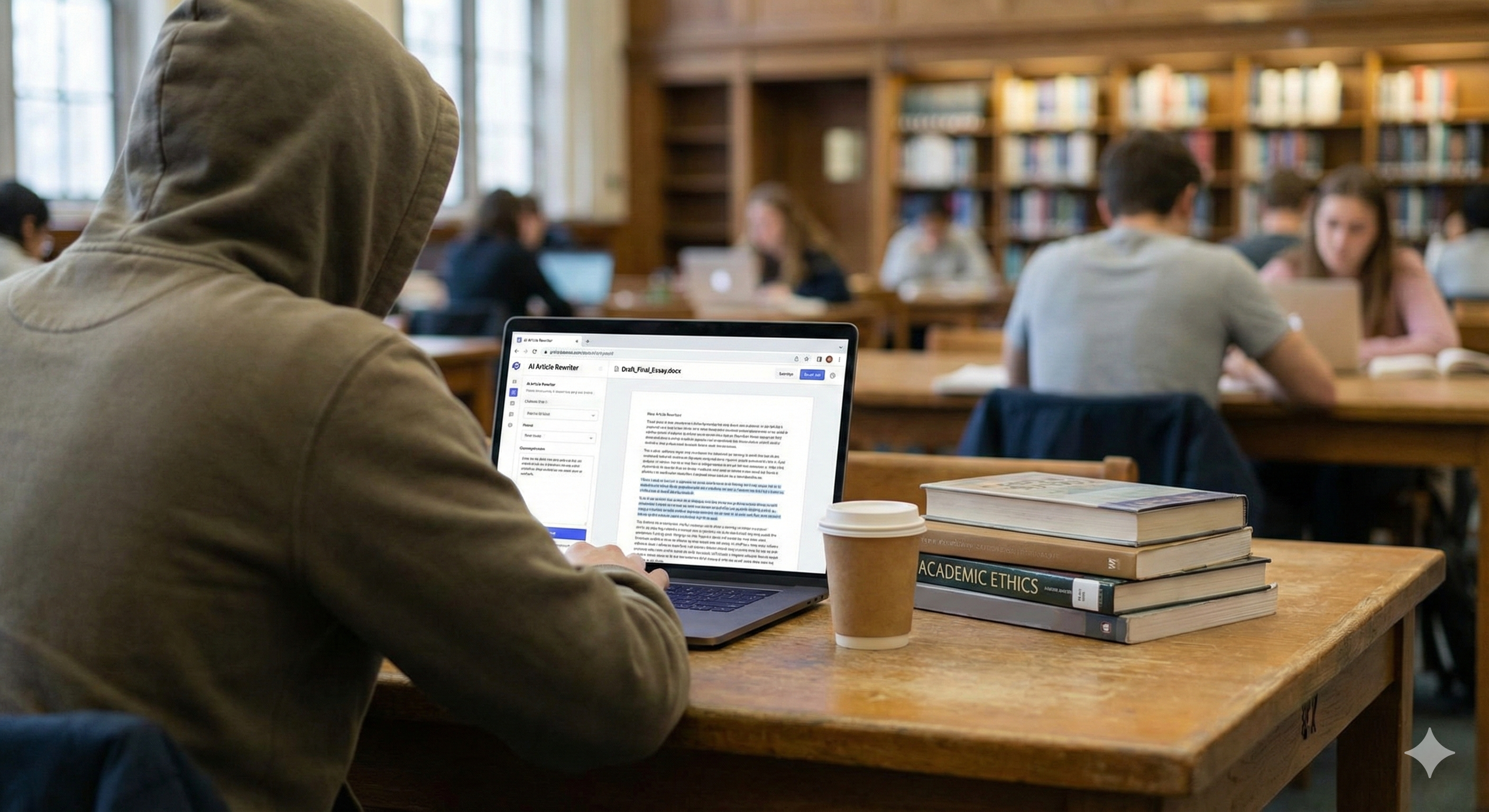
The library at 2 AM smells like coffee, desperation, and the particular brand of anxiety that only emerges during finals week. You're hunched over your laptop, surrounded by half-empty energy drink cans, staring at a research paper that needs to be submitted in six hours. The sources are perfect, your argument is solid, but there's one problem: you've accidentally copied too much text from your research materials. Sound familiar? You're not alone.
In 2026, the academic landscape has shifted dramatically. Students aren't just battling deadlines and demanding professors; they're navigating a complex ecosystem of AI-powered writing tools, sophisticated plagiarism detection systems, and evolving university policies that seem to change faster than you can say "academic integrity." The rise of online article rewriter tools has created both opportunities and ethical minefields for students trying to maintain their academic integrity while producing original work.
The New Reality: Why Students Turn to Article Rewriters
Let's be honest about why these tools have become indispensable in modern academic life. The pressure cooker environment of higher education has intensified exponentially. International students face the additional challenge of writing in their second or third language. Non-native English speakers often understand complex concepts perfectly but struggle to express them with the fluency expected in Western academic institutions.

Time constraints represent another brutal reality. Between part-time jobs, family obligations, and the astronomical cost of tuition, many students find themselves in impossible situations. A single mother working two jobs to pay for her psychology degree doesn't have the luxury of spending six hours crafting the perfect paraphrase of a dense research article. She needs tools that can help her work more efficiently without compromising her academic standing.
The democratization of education has also meant that classrooms are more diverse than ever, but academic support systems haven't evolved at the same pace. Students from different educational backgrounds arrive at university with varying levels of preparation for academic writing. Some have never been properly taught how to paraphrase effectively, making them unintentionally vulnerable to plagiarism accusations.
Understanding the Tool Landscape: What Actually Works
The market for paraphrasing tools has exploded, but not all solutions are created equal. After testing dozens of platforms and analyzing user feedback from thousands of students, certain patterns emerge that separate genuinely helpful tools from digital snake oil.
QuillBot stands out as the current market leader, and for good reason. The platform offers multiple modes specifically designed for academic writing, including a formal mode that maintains scholarly tone and a fluency option that helps non-native speakers sound more natural. The real magic happens in its ability to preserve technical terminology while restructuring sentences. When you're writing about "photosynthetic electron transport chain mechanisms," you don't want your tool randomly replacing technical terms with inaccurate synonyms.
However, Grammarly's paraphrasing capabilities shouldn't be overlooked, particularly for students who prioritize grammatical accuracy. While QuillBot excels at sentence restructuring, Grammarly's AI understands context in ways that prevent embarrassing errors. The platform recently introduced genre-specific suggestions that recognize academic writing conventions, making it invaluable for students who need to maintain formal tone while improving clarity.
For those seeking specialized academic tools, Jenni AI has carved out a niche by focusing specifically on research writing. Unlike general-purpose rewriters, Jenni understands citation patterns, academic formatting, and the nuanced differences between disciplines. A biology paper requires different paraphrasing approaches than a literature review, and Jenni's algorithms reflect this understanding.
The Ethics Question: Where Universities Draw the Line
Here's where things get complicated. University policies haven't kept pace with technological advancement, creating a gray area that leaves many students confused and vulnerable. The University of Bristol's recent implementation of AI paraphrasing detection capabilities represents a watershed moment in academic integrity enforcement. Starting in July 2024, Turnitin's enhanced algorithms can now identify text that was likely AI-generated and then processed through paraphrasing tools.
This development has sent shockwaves through student communities worldwide. The technology works by analyzing writing patterns, sentence structures, and linguistic markers that distinguish human writing from AI-processed text. Text that was AI-generated and then run through tools like QuillBot gets flagged with purple highlighting, while purely AI-generated content appears in cyan. This level of scrutiny means students can no longer rely on simple paraphrasing to mask AI assistance.
However, the situation isn't as dire as it might seem. University officials emphasize that Turnitin evidence supplements rather than replaces academic judgment. The key distinction lies in how you use these tools. Using paraphrasing software to help express your own ideas more clearly falls within acceptable boundaries. Using them to disguise content you didn't create crosses ethical lines.
The Smart Approach: How to Use Rewriters Without Getting Burned
Successful students have developed sophisticated strategies for leveraging these tools while maintaining academic integrity. The process begins with understanding that paraphrasing tools should enhance your writing, not replace your thinking.
Start by writing your initial draft using your own words and understanding. This becomes your intellectual foundation – the ideas, arguments, and analysis belong to you. Then, use paraphrasing tools strategically to improve clarity, vary sentence structure, or find better ways to express complex concepts you've already grasped.
The ethical framework developed by Cambridge Proofreading provides excellent guidance: always cross-reference paraphrased sections with original sources, combine automated suggestions with your own analysis, and use plagiarism detection tools to verify uniqueness before submission. Think of AI paraphrasing as having a brilliant writing tutor available 24/7, not as a ghostwriter who does your work for you.
Proper citation remains crucial, even when you've paraphrased extensively. Many students mistakenly believe that running text through a paraphrasing tool eliminates the need for attribution. This couldn't be further from the truth. If the ideas originated from another source, you must cite them, regardless of how much the wording has changed.
The Technical Deep Dive: How Modern Paraphrasing Actually Works
Understanding the technology behind these tools helps explain why some work better than others and why universities can detect their use. Modern paraphrasing tools employ several layers of natural language processing to rewrite text while preserving meaning.
The first layer involves semantic analysis, where the AI breaks down sentences into their core components: subjects, verbs, objects, and modifying phrases. Advanced systems like QuillBot's academic mode recognize domain-specific terminology and protect it from unnecessary changes. This prevents the tool from replacing "mitochondria" with "cell powerhouse" in a biology paper.
The second layer focuses on syntactic restructuring. Rather than simply swapping synonyms, sophisticated tools rearrange sentence structures, change passive voice to active (or vice versa), and break complex sentences into simpler ones while maintaining logical flow. This is where the real magic happens – transforming "The experiment was conducted by researchers to determine the effects" into "Researchers conducted the experiment to determine the effects."
The final layer involves stylistic adaptation. Premium tools offer different modes that adjust formality, academic tone, and complexity levels. This allows students to match their institution's expectations while ensuring the paraphrased text sounds natural and human-written.
Real-World Application: A Student's Workflow That Actually Works
Let me walk you through a workflow that successful students use, based on extensive interviews and testing. Sarah, a graduate student in environmental science, agreed to share her approach to using paraphrasing tools ethically and effectively.
Sarah begins her research process by taking detailed notes in her own words, ensuring she understands the material before attempting to write. She uses a color-coding system: direct quotes in red, paraphrased ideas in blue, and her own analysis in green. This visual approach helps her track which ideas require citation.
When writing her literature review, Sarah first drafts sections using her understanding of the research. She then uses QuillBot's academic mode to help rephrase particularly dense technical passages, always comparing the output to her original understanding. "If the paraphrased version changes the meaning or loses important nuances, I manually adjust it," she explains.
The crucial step comes next: Sarah runs her entire paper through Grammarly for grammar and style checking, then uses Turnitin's student portal to check for any accidental plagiarism before final submission. This multi-layered approach has helped her maintain a 3.9 GPA while working full-time as a research assistant.
The Comparison Table: Making Sense of Your Options
Table
Copy
| Tool | Best For | Academic Strengths | Limitations | Pricing |
|---|---|---|---|---|
| QuillBot | General paraphrasing | Multiple academic modes, preserves technical terms | Limited free version, no mobile app | Free/$4.17 monthly |
| Grammarly | Grammar + style | Contextual understanding, integration everywhere | Basic paraphrasing features | Free/$12 monthly |
| Jenni AI | Research writing | Citation awareness, academic formatting | Newer platform, smaller user base | Free/Premium $20 |
| MyEssayWriter.ai | Essay structure | Maintains argument flow, tone consistency | Limited to essay formats | Free/$15 monthly |
| PaperPal | Academic refinement | Research-specific suggestions | Requires understanding of field | Free/$30 monthly |
The Future Landscape: What's Coming Next

The arms race between paraphrasing tools and detection systems shows no signs of slowing. Industry insiders predict that the next generation of tools will focus on "human emulation" – producing text that mimics individual writing styles while maintaining originality. This development raises fascinating questions about the nature of academic writing and intellectual property.
Universities are responding by evolving their assessment methods. Many institutions are moving toward process-based evaluation, where students submit drafts, research notes, and revision histories rather than just final papers. This approach values the learning journey over the final product, making it harder to game the system with AI tools.
The integration of blockchain technology for academic writing is another emerging trend. Some platforms are experimenting with immutable records of writing processes, creating verifiable trails that prove original authorship while still allowing for legitimate paraphrasing assistance.
Practical Strategies for Different Academic Disciplines
The approach to ethical paraphrasing varies significantly across academic disciplines. Science and engineering students often need to preserve technical terminology while rephrasing explanatory text. Tools like PaperPal excel here because they understand that "polymerase chain reaction" shouldn't become "protein copying process."
Humanities students face different challenges. When analyzing Shakespeare or discussing philosophical concepts, the nuance of language becomes crucial. The best approach involves using paraphrasing tools for structural suggestions while manually crafting the final wording to preserve intended meanings and interpretations.
Business and social science students must balance accessibility with academic rigor. Their writing needs to be sophisticated enough for academic audiences while remaining comprehensible to practitioners. This requires careful use of paraphrasing tools that can simplify without dumbing down complex theories.
The Bottom Line: Your Academic Success Strategy
The key to successfully using online article rewriters lies in viewing them as sophisticated writing assistants rather than magical solutions. Start with your own understanding, use tools to enhance clarity and expression, and always maintain proper attribution for ideas that aren't originally yours.
Remember that these tools are meant to amplify your intellectual capabilities, not replace them. The most successful students combine technological assistance with genuine learning, using paraphrasing tools to help express complex ideas more clearly while developing their own analytical skills.
The future of academic writing isn't about choosing between human intelligence and artificial assistance – it's about finding the sweet spot where technology enhances human capability without replacing the critical thinking and original analysis that form the foundation of meaningful education.
As you navigate your academic journey, approach these tools with both enthusiasm for their capabilities and respect for their limitations. Use them wisely, ethically, and always in service of your own learning and growth. The goal isn't just to produce papers that pass plagiarism checks; it's to develop the kind of sophisticated writing and thinking skills that will serve you throughout your career.
The student hunched over their laptop at 2 AM doesn't need to choose between academic integrity and meeting deadlines. With the right approach, the right tools, and the right mindset, you can produce original, thoughtful work that reflects your genuine understanding while leveraging technology to work more efficiently and effectively. That's not just academic success – that's preparation for a future where human intelligence and artificial assistance work together to achieve remarkable things.