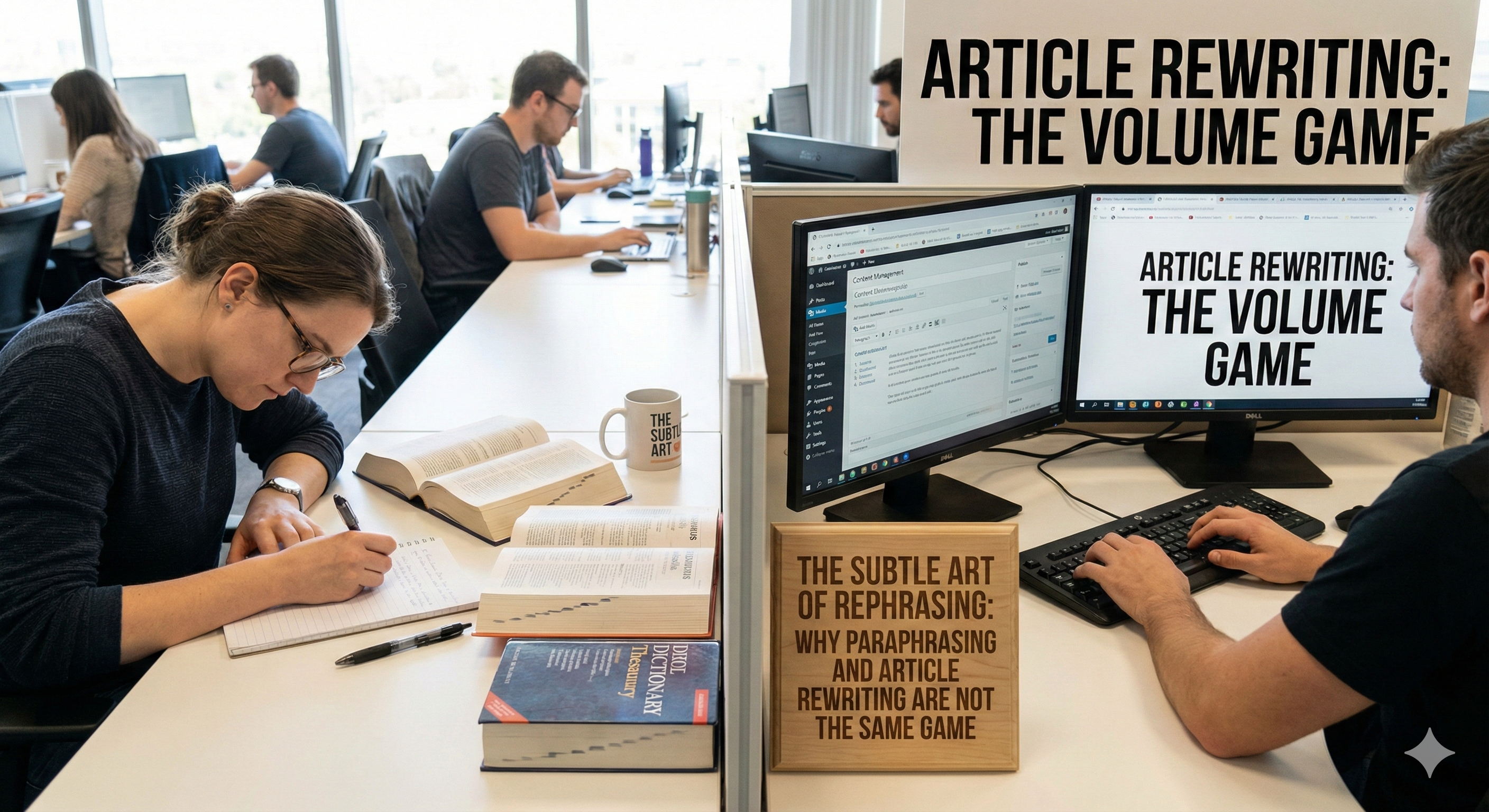
The Subtle Art of Rephrasing: Why Paraphrasing and Article Rewriting Are Not the Same Game

The cursor blinks at you from a blank document. Your deadline breathes down your neck. Across the room, a competitor's blog post sits open in another tab, its ideas solid but its execution leaving room for improvement. You could swap out a few words here, shuffle some phrases there, and call it a day. Or you could tear the whole thing down to its studs and rebuild it into something unrecognizable, something with your fingerprints all over it. These two paths—seemingly similar, fundamentally different—represent the quiet battlefield where content creators either win or fade into the digital noise.
Welcome to the distinction that separates the hobbyists from the professionals. Paraphrasing and article rewriting share DNA, yet they operate at entirely different altitudes. One is a surgical strike. The other is a ground-up renovation. Understanding which tool to reach for, and when, will define whether your content sings or merely hums along.
The Core Distinction: Two Paths from the Same Starting Line
Let's strip away the confusion right now. Paraphrasing is the art of restating specific passages using fresh vocabulary while keeping the architecture intact. You take someone else's sentence—its bones, its rhythm, its essential message—and you paint it a new color. The frame doesn't change. The studs remain where they are. You're simply choosing different words to express the same idea in roughly the same space.
Picture a sommelier describing a wine. If the original text says, "The 2018 Bordeaux presents a robust tannic structure with notes of blackcurrant and cedar," a paraphrase might read, "This 2018 Bordeaux delivers a strong tannic backbone alongside blackcurrant and cedar aromas." The substance is identical. The words are different. The sentence length and structure remain close cousins.
Article rewriting, meanwhile, is a more radical act. It's not about swapping vocabulary—it's about reimagining the entire piece. You keep the central concept, sure, but everything else becomes negotiable. Tone, structure, examples, flow, even the angle of attack can shift. Where paraphrasing is cosmetic, rewriting is architectural.
Think of it this way: paraphrasing is when you tell your friend about a movie you just saw, using your own words but hitting the same plot points. Rewriting is when you adapt that movie into a stage play set in a different era with new characters but the same thematic heart. One preserves the form. The other reinvents it.
The SEO Tightrope: How Google Actually Judges Your Word Choices
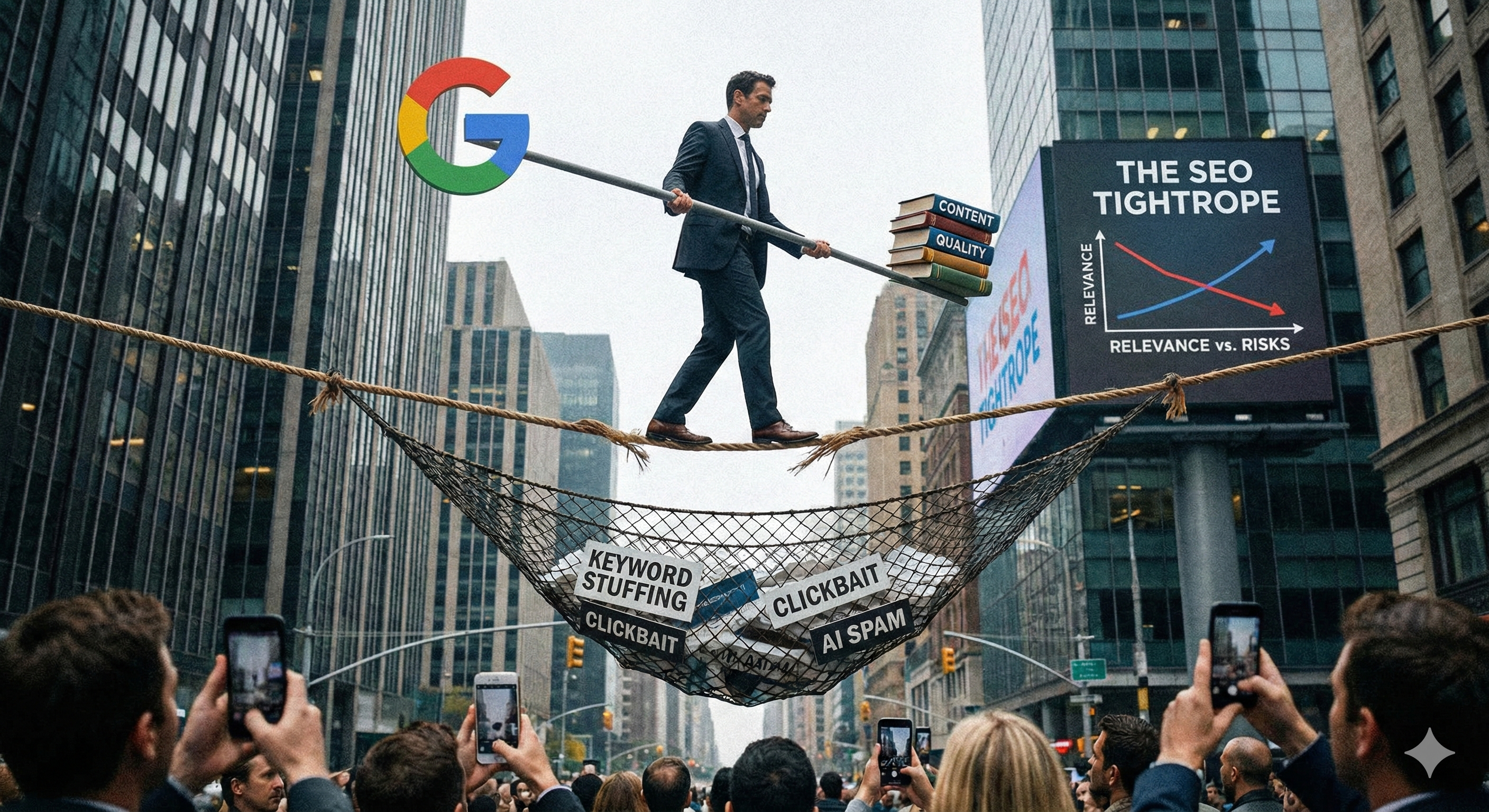
Google's algorithm has developed a sophisticated palate. The Helpful Content Update sent a clear message through the industry: surface-level tricks no longer work. The search giant can distinguish between content that genuinely serves readers and text that exists merely to game the system.
This matters enormously for our conversation. Paraphrasing a competitor's article with minor word substitutions—what some call content spinning—triggers Google's spam detectors. The search engine's patent from October 2013 specifically targets automatic rewriting of identical pages to dodge duplicate content flags. If your "new" version retains the same structure, rhythm, and informational flow as the source material, you're not creating content. You're photocopying with a thesaurus, and Google sees right through it.
Rewriting, done properly, tells a different story. When you rebuild an article from the ground up—introducing fresh research, interviewing new sources, restructuring the argument, injecting your brand's voice—you're creating something Google recognizes as original. The search engine's EEAT principles (Experience, Expertise, Authoritativeness, Trustworthiness) demand this level of transformation. You're not just avoiding penalties; you're building equity.
The distinction shows up in your analytics. A lightly paraphrased piece might rank briefly, then tumble as Google identifies its borrowed skeleton. A thoroughly rewritten article—one that adds genuine value through new insights or perspectives—can climb steadily, earning backlinks and user engagement that signal true worth.
The Tool Landscape: AI Assistance vs Human Craft

Today's content creator faces a tempting array of digital helpers. QuillBot stands as the Swiss Army knife of paraphrasing, offering modes from Standard to Fluency, even letting you adjust synonym intensity with a clever slider. Wordtune approaches the task more like a writing coach, suggesting ten alternative phrasings for any sentence you highlight. Jasper and Copy.ai handle broader content creation, including rewriting capabilities that can reshape entire paragraphs.
These tools operate at lightning speed. They can process 500 words in seconds, integrate with Google Docs, and churn out variations faster than any human. For pure paraphrasing tasks—especially when you're stuck on a single sentence—they're invaluable. The best paraphrasing tools of 2024 have grown remarkably sophisticated, using natural language processing to understand context and preserve meaning.
But here's where the conversation gets interesting. A recent study from Hastewire found that AI-paraphrased text gets flagged by detection tools like GPTZero and Originality.ai between 70-90% of the time. The pattern recognition that makes these tools effective also leaves fingerprints—repetitive structures, predictable phrasing, a certain mechanical rhythm that human readers sense unconsciously. Even when the words change, the architecture often betrays its digital origin.
Manual rewriting operates differently. It begins with deep reading, not just of the words but of the spaces between them. What is the author really saying? What questions remain unasked? Which examples feel dated? A human rewriter brings personal experience, cultural nuance, and conversational intuition to the table. They might transform a dry technical explanation into a story-driven narrative. They could swap generic examples for specific, timely case studies. They hear the rhythm of a sentence and break it apart, creating variety that holds attention.
The time investment isn't comparable. What takes AI seconds might demand hours of human work. But the result—a piece that passes AI detection, earns genuine backlinks, and resonates with readers—justifies the effort for content that matters.
When to Paraphrase, When to Rewrite: Strategic Decision-Making
Smart creators don't choose sides. They read the situation and pick the right tool.
Reach for paraphrasing when:
You're citing research and need to integrate a statistic or finding into your own narrative
You want to reference a concept from another source without quoting directly
You're refreshing your own existing content line-by-line
The original structure serves your purposes, but the wording feels off-brand
Choose rewriting when:
An old post performed poorly and needs a complete strategic overhaul
You're targeting a different audience segment with the same core information
The source material is solid but the examples, data, or tone are outdated
You want to establish thought leadership by building on someone else's foundation
The table below crystallizes these differences for quick reference:
Table
Copy
| Element | Paraphrasing | Article Rewriting |
|---|---|---|
| Scope | Word and phrase level | Structural and strategic level |
| Time Investment | Minutes to hours | Hours to days |
| AI Tool Suitability | Excellent | Moderate (requires heavy editing) |
| SEO Risk | High if overused | Low when adding original value |
| Purpose | Preserve meaning, adjust wording | Transform meaning, add fresh perspective |
| Best For | Citations, quick refreshes, avoiding plagiarism | Underperforming content, audience shifts, brand differentiation |
| Google's View | Suspicious if mechanically done | Favorable when value-added |
| Skill Required | Basic writing proficiency | Advanced writing and strategic thinking |
The Ethics Playground: Staying on the Right Side of Originality
Here's where many creators stumble. Paraphrasing, especially with AI assistance, can become a slippery slope into plagiarism. The key is understanding that paraphrasing requires citation just as much as direct quoting does. When you borrow someone's idea, even in new words, you're building on their intellectual property.
The best practices to avoid plagiarism are straightforward but non-negotiable. Keep meticulous track of your sources during research. Use quotation marks for any phrase you lift directly, even if it's just a striking three-word combination. When you paraphrase, attribute the original author in your text: "According to Patel's analysis..." with a link back.
Article rewriting, when it involves others' work, demands even more care. True rewriting means adding so much original thought and research that the final piece becomes distinctly yours. If you're simply reworking someone else's article without new interviews, data, or perspectives, you're not rewriting—you're plagiarizing with extra steps.
The consequences extend beyond moral discomfort. Search engines penalize plagiarized content with ranking drops. Your reputation suffers when readers spot recycled ideas. Legal action, while rare, remains possible. Most importantly, you rob yourself of the chance to build genuine authority in your space.
The Future of Textual Transformation
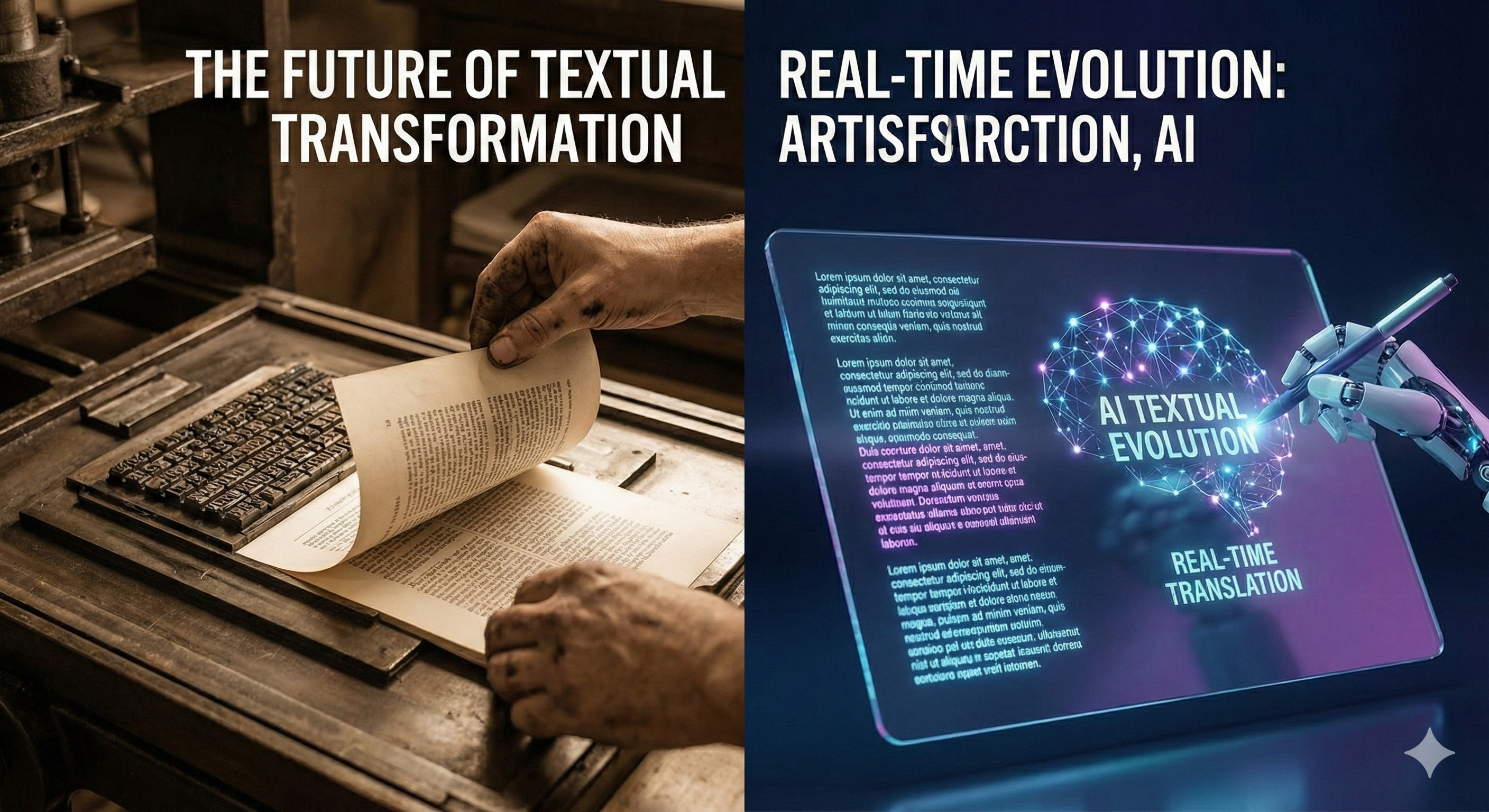
The arms race between content creation and detection shows no signs of slowing. Google continues refining its ability to spot surface-level rephrasing while rewarding depth and originality. AI tools grow more sophisticated, but so do detection algorithms. This creates a fascinating tension in the industry.
Forward-thinking creators are adopting hybrid workflows. They use AI for first-draft paraphrasing and idea generation, then apply human editing to inject voice, verify facts, and restructure for impact. This approach combines speed with quality, though it requires careful oversight. The key is treating AI output as clay, not as a finished sculpture.
We're also seeing a rise in what might be called "transformative rewriting"—taking a mediocre article and turning it into an interactive piece, a video script, an infographic narrative, or a podcast episode. This moves beyond textual changes into true format innovation, something AI still struggles to do effectively.
Your Move: Action Steps for Immediate Implementation
Stop right now and audit your last five pieces of content. Ask yourself honestly: did I paraphrase when I should have rewritten? Did I add genuine value or just rearrange existing words?
If you're working with a team, establish editorial guidelines that define when paraphrasing is acceptable and when a full rewrite is required. Create a checklist: Does this piece include original research? New expert quotes? A fresh angle? If not, you're probably not rewriting—you're recycling.
For solo creators, develop a personal system. Bookmark sources meticulously. Use a plagiarism checker religiously, aiming for less than 2% matched text. But more importantly, cultivate the discipline of adding one unique insight to every piece you produce, even when building on others' work.
Consider your audience's evolving sophistication. Readers can sense recycled content. They leave comments like, "This feels familiar," or worse, they simply stop returning. Originality, even when covering well-trodden ground, becomes your competitive moat.
The Bottom Line
Paraphrasing and article rewriting occupy different galaxies in the content universe. One is a tactical tool for integrating sources and maintaining flow. The other is a strategic weapon for building authority and dominating search results. Confuse them at your peril.
The creators who win in today's landscape aren't those who produce the most content, but those who produce the most valuable content. Sometimes that means a quick paraphrase with proper attribution. More often, it means rolling up your sleeves and rewriting a piece until it bears your unmistakable signature.
Your content is your reputation. Treat it accordingly. Whether you reach for QuillBot or your own well-trained brain, make sure the final product adds something to the conversation. The internet doesn't need more echo chambers. It needs your voice—clear, original, and impossible to ignore.
What will your next piece be: a clever echo or a fresh voice? The choice, and the consequences, are yours alone.